
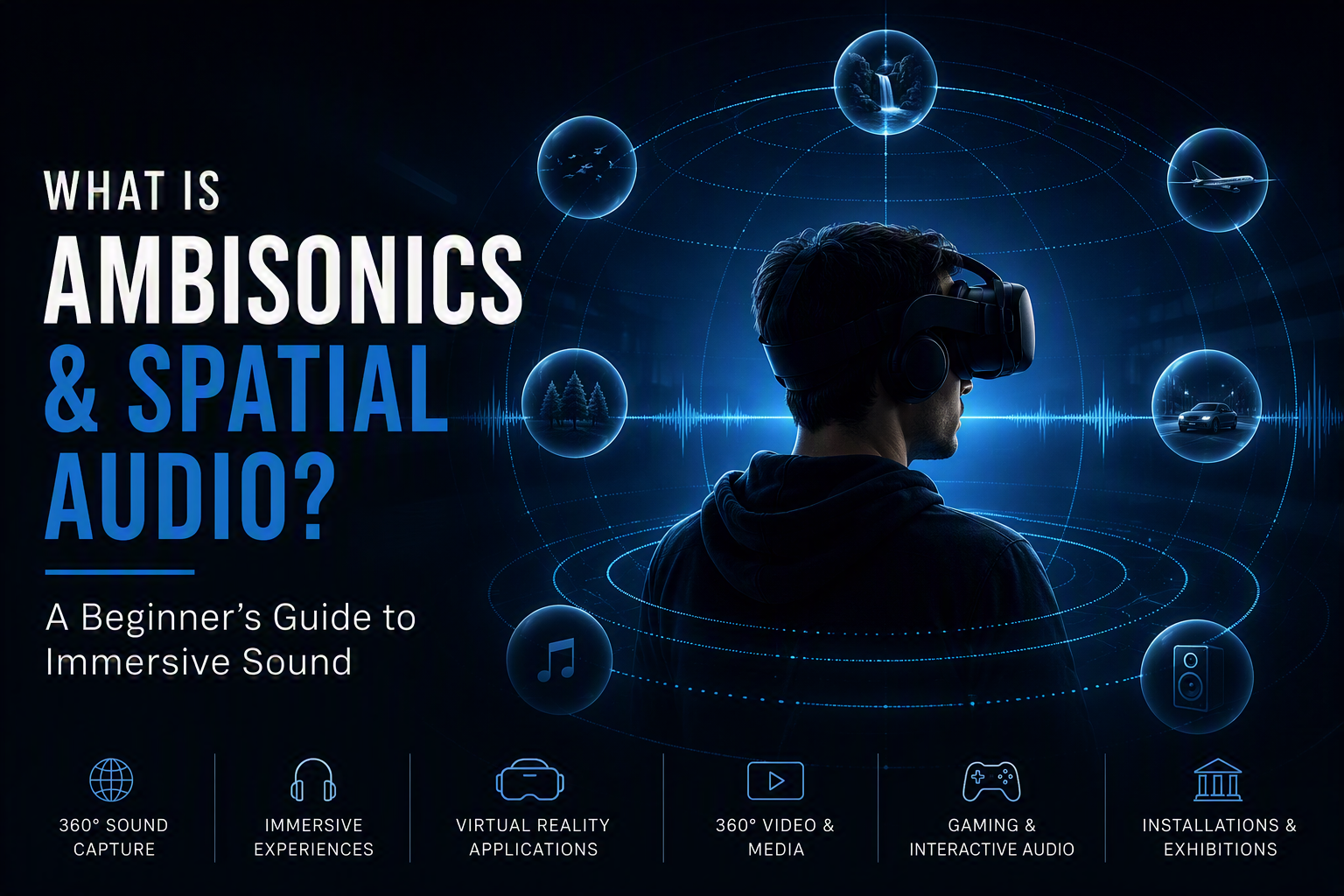
What is Ambisonics and Spatial Audio? A Beginner's Guide to Immersive Sound
Understanding the Future of Audio
When we think about audio, most people are familiar with mono (one channel) and stereo (left and right channels). But as technology evolves, so do the ways we experience sound.
Virtual Reality (VR), Augmented Reality (AR), 360° video, gaming, and immersive installations have all created a growing demand for audio that feels more realistic and engaging. This is where spatial audio and ambisonics come into play.
In this beginner's guide, we'll explain what these technologies are, how they differ from traditional audio formats, and why they are becoming increasingly important in modern content creation.
What is Spatial Audio?
Spatial audio is a technology that allows sound to be positioned within a three-dimensional space.
Instead of hearing audio only from the left or right speaker, listeners perceive sounds as coming from above, below, behind, in front, and all around them.
Imagine standing in a forest:
- Birds chirping overhead
- Wind rustling through trees behind you
- A stream flowing to your left
- Footsteps approaching from in front
Spatial audio recreates this natural listening experience by placing sounds accurately within a virtual environment.
The result is a significantly more immersive and realistic experience than conventional stereo audio.
What is Ambisonics?
Ambisonics is a method of recording, storing and reproducing three-dimensional sound.
Unlike traditional microphone techniques, ambisonic recordings capture the entire sound field surrounding the microphone rather than recording only specific directions.
Think of ambisonics as a 360-degree camera for audio.
Rather than deciding where sounds should be placed during recording, ambisonics captures everything around the microphone. During playback, the audio can then be rendered according to where the listener is looking or moving.
This flexibility makes ambisonics one of the most popular formats for immersive audio production.
How Does Ambisonics Work?
An ambisonic microphone contains multiple microphone capsules that capture sound arriving from all directions.
The recorded signals are combined into a format that preserves directional information.
When played back through:
- Headphones
- Virtual Reality headsets
- Multi-speaker systems
- Interactive applications
the audio engine can calculate exactly how the sound should be heard based on the listener's position and orientation.
For example:
If you're watching a VR experience and turn your head to the right, sounds that were originally behind you remain behind you, just as they would in the real world.
This dynamic behaviour is what helps create a convincing sense of presence.
Ambisonics vs Stereo Audio
Stereo Audio
- Two channels (left and right)
- Fixed listening perspective
- Excellent for music and traditional media
- Limited immersion
Ambisonics and Spatial Audio
- Three-dimensional sound field
- Supports head tracking
- Greater realism and immersion
- Ideal for interactive experiences
Stereo audio tells a listener where sound sits between two speakers.
Spatial audio tells a listener where sound exists within an environment.
Why is Spatial Audio Important?
Humans naturally use sound to understand the world around us.
Our brains constantly process information such as:
- Direction
- Distance
- Movement
- Environment size
- Reflections and echoes
Spatial audio recreates these natural auditory cues, making digital experiences feel more authentic.
This increased realism offers several benefits:
Enhanced Immersion
Listeners feel more present within a virtual environment.
Improved Storytelling
Creators can guide attention through sound and create more emotional engagement.
Increased Accessibility
Spatial audio can provide important navigational cues within virtual environments.
More Natural Experiences
Users intuitively understand where sounds are coming from, reducing cognitive effort.
Applications of Ambisonics and Spatial Audio
Virtual Reality (VR)
VR is perhaps the most well-known application.
Without spatial audio, virtual environments can feel artificial and disconnected.
With ambisonic audio, users experience:
- Directional sound sources
- Realistic environments
- Greater presence
- Improved immersion
A virtual concert, museum tour or training simulation becomes significantly more convincing when sound behaves naturally.
Augmented Reality (AR)
AR overlays digital content onto the real world.
Spatial audio helps digital objects feel like they genuinely exist within the user's physical environment.
For example:
A navigation application could provide directional cues that appear to originate from the correct locations around the user.
Gaming
Modern game engines such as Unity and Unreal Engine increasingly support spatial audio workflows.
Benefits include:
- Improved situational awareness
- More immersive environments
- Enhanced player engagement
- Better storytelling
Players can identify where threats, characters or events are occurring through sound alone.
360° Video Production
Platforms such as YouTube and Meta support ambisonic audio for immersive video experiences.
When viewers change their viewing angle, the audio perspective updates accordingly.
This creates a far richer experience compared to traditional video soundtracks.
Museums, Exhibitions and Installations
Interactive exhibits increasingly use spatial audio to create engaging visitor experiences.
Applications include:
- Historical recreations
- Interactive storytelling
- Educational environments
- Immersive exhibitions
The Future of Immersive Audio
Spatial audio is rapidly becoming a standard feature across many technologies.
As:
- VR adoption grows
- AR devices become more common
- Mixed Reality experiences develop
- Immersive content becomes mainstream
the demand for spatial audio expertise will continue to increase.
Major technology companies including Apple, Meta, Sony and Microsoft are all investing heavily in immersive technologies, making high-quality spatial audio more important than ever.
How Rowland Records Can Help
At Rowland Records, we're passionate about creating audio that goes beyond traditional stereo production.
Whether you're developing:
- Virtual Reality experiences
- 360° video content
- Interactive installations
- Immersive storytelling projects
- Spatial audio productions
we can help design, edit, mix and optimise audio for modern immersive platforms.
As immersive technologies continue to evolve, sound will play an increasingly important role in creating unforgettable experiences.