
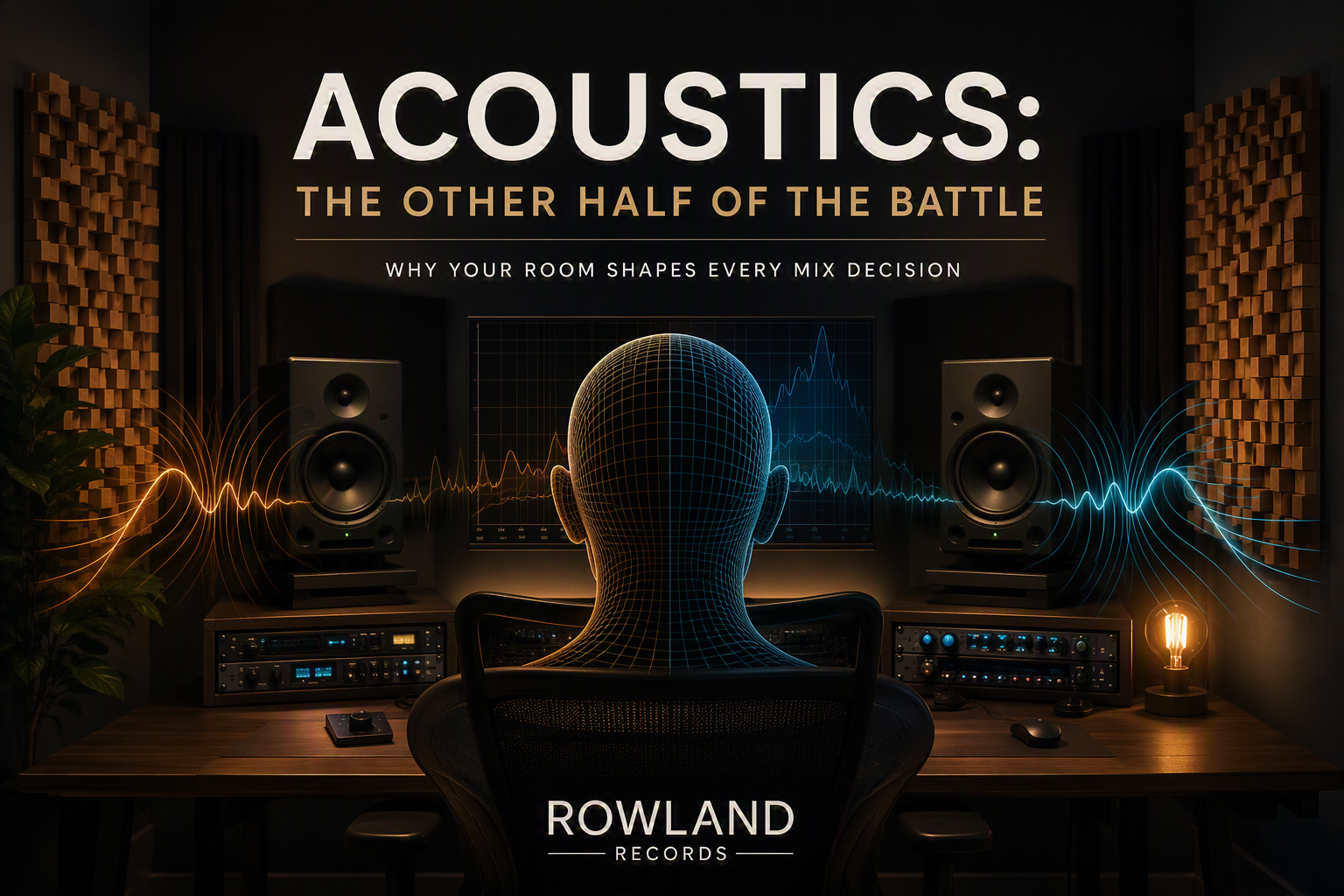
Acoustics: The Other Half of the Battle
Why your room matters just as much as your gear.
Walk into any home studio forum and you'll find endless discussions about microphones, plugins, converters, monitors and the latest AI-powered mixing tools. While all of these things matter, there's one critical part of the signal chain that often gets overlooked:
The room itself.
The reality is that your listening environment is responsible for a huge portion of what you hear when making mix decisions. Even the most accurate monitors in the world can only reproduce what the room allows you to hear. If your room is exaggerating bass frequencies, creating strong reflections, or introducing resonances, you're not hearing the truth—you're hearing the room.
In many ways, acoustics are half the battle when it comes to producing mixes that translate well outside your studio.
Why Acoustics Matter for Mixing
Every mixing decision you make relies on perception.
When you boost the low end of a kick drum, adjust the stereo width of a guitar, or tame a harsh vocal frequency, you're trusting that what reaches your ears accurately represents the source material.
Unfortunately, untreated rooms rarely cooperate.
Reflections from walls, ceilings and desks arrive at your ears milliseconds after the direct sound from your monitors. These reflections interact with the original signal, creating comb filtering, phase interactions and frequency response anomalies that can dramatically alter your perception.
The result?
- Bass frequencies that appear louder or quieter than they really are.
- Stereo imaging that lacks precision.
- Reverberation and ambience that are difficult to judge accurately.
- Mixes that sound great in the studio but fall apart everywhere else.
A well-treated room removes much of this uncertainty, allowing you to make decisions based on the audio rather than the acoustical behaviour of the space.
The Science of Spatial Hearing
One of the most fascinating aspects of room acoustics lies in how our brains determine the location of sound.
Two key mechanisms are at work:
Interaural Time Difference (ITD)
Interaural Time Difference refers to the tiny difference in arrival time between each ear.
If a sound originates to your left, it reaches your left ear slightly before your right ear. Your brain uses these minute timing differences to determine the position of the sound source.
Interaural Level Difference (ILD)
Interaural Level Difference refers to the difference in sound level arriving at each ear.
A sound arriving from one side of your head will often be slightly quieter at the opposite ear due to the acoustic shadowing effect of the head itself.
Together, ITD and ILD form a fundamental part of our ability to localise sound and build a three-dimensional sense of the acoustic world.
Why Room Acoustics Affect These Cues
The problem is that your room introduces additional information that wasn't present in the original recording.
Early reflections and resonances create competing arrival times and level differences that can interfere with your brain's interpretation of the direct sound from your monitors.
In simple terms, the room can distort the transfer function between:
Speakers → Room → Ears → Brain
When this transfer function becomes compromised, stereo imaging suffers, panning decisions become less reliable and the overall perception of depth and space in a mix becomes harder to evaluate.
This is one reason why professionally treated control rooms often feel effortless to work in. The room has been engineered to preserve these important psychoacoustic cues as accurately as possible.
Headphones and Room Simulation: Powerful, But Not Perfect
Modern headphone mixing workflows have improved dramatically.
Room simulation software, crossfeed processing and spatial modelling technologies give engineers access to remarkably useful monitoring solutions. For many home producers, these tools are an invaluable part of the workflow.
However, most virtual room simulations rely on some form of averaged Head-Related Transfer Function (HRTF).
An HRTF describes how sound is filtered by a person's:
- Head shape
- Ear geometry (pinnae)
- Torso
- Shoulder positioning
Since every listener is physically different, an averaged HRTF represents only a statistical approximation of how sound interacts with the human body.
While these systems can create impressive spatial effects and improve headphone monitoring, they cannot perfectly replicate the unique transfer function of your own anatomy.
This doesn't mean the technology isn't useful—it absolutely is—but it's important to understand its limitations.
Your ears are unique.
Your room is unique.
And ultimately your brain interprets sound through a highly individual acoustic pathway.
Engineering a Better Listening Environment
The goal of room treatment isn't necessarily to create a perfectly dead space.
The goal is to create a predictable and trustworthy listening environment.
Achieving this requires a combination of acoustic tools, including:
Absorption
Used to reduce unwanted reflections and control excessive reverberation.
Diffusion
Breaks up reflections and distributes acoustic energy more evenly throughout the room.
Resonant Treatment
Helmholtz resonators and specialised bass trapping solutions can target problematic low-frequency resonances that standard absorbers struggle to control.
When applied correctly, these techniques help smooth frequency response, improve stereo imaging and reduce destructive room interactions.
The result is a monitoring environment where decisions become faster, easier and more reliable.
Enter Modern Correction Technology
A particularly exciting development in recent years is the integration of measurement-based room correction systems directly into monitoring workflows.
Products such as the Audient ORIA and ORIA Mini take an increasingly sophisticated approach by using calibrated room measurements and inverse filtering techniques to compensate for both monitor response and room-induced frequency anomalies.
The concept is straightforward:
- Measure the response of the room and monitoring system.
- Identify deviations from the desired target response.
- Apply carefully calculated corrective filtering.
- Deliver a more accurate monitoring experience.
While acoustic treatment should always remain the foundation of a good listening environment, these technologies can provide an additional layer of refinement that helps bridge the gap between real-world rooms and ideal monitoring conditions.
The Takeaway
The best microphone, the most expensive monitors and the latest plugins cannot fix a room that is misleading you.
Acoustics influence everything from frequency balance to stereo imaging, from localisation cues to mix translation. Understanding how interaural time and level differences interact with room reflections provides a deeper appreciation of why room treatment remains one of the most valuable investments a studio owner can make.
When acoustics, psychoacoustics and modern correction technology work together, something remarkable happens:
You stop fighting the room.
And when you can finally trust what you're hearing, every mixing decision becomes easier.
At Rowland Records, we believe great records are built on truth, not guesswork. Treat your room, trust your ears, and create with confidence.